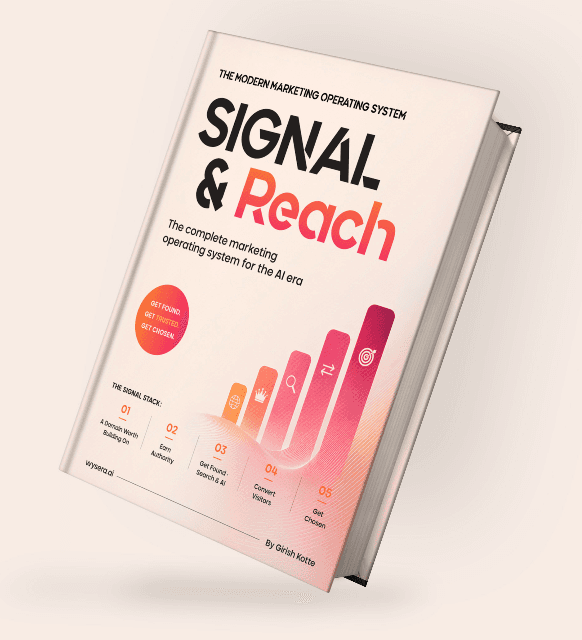
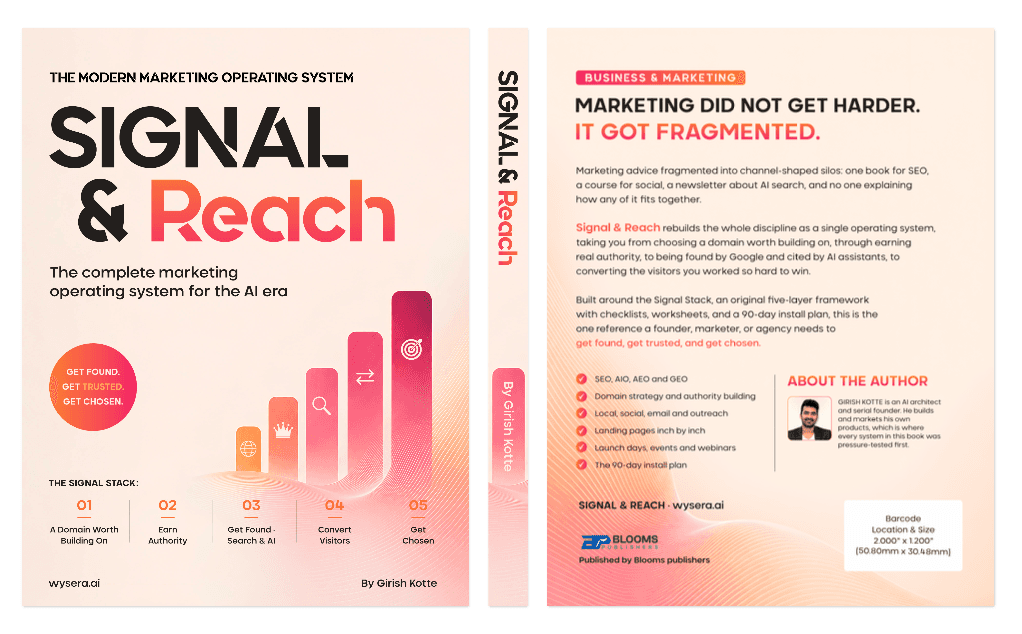
One book for SEO, a course for social, a newsletter about AI search, and nobody explaining how any of it fits together. Signal & Reach rebuilds the whole discipline as a single operating system.
From choosing a domain worth building on, through earning real authority, to being found by Google and cited by AI assistants, to converting the visitors you worked so hard to win.
More channels than any marketer has ever had, and less certainty about which of them matter. The trailer is the argument in short form; the 512 pages are the argument in full.
Why this book, why now
When the intermediary reads a thousand sources and answers in one paragraph, being on page one is no longer the goal. Being in the paragraph is.
Three shifts landed in the same decade and ended marketing as a collection of independent channels.
01
The machines became the audience
Your content now has two audiences with different needs: humans, who buy on emotion and trust, and machines, which decide whether humans ever see you at all.
02
Every channel saturated at once
The marginal cost of publishing fell to zero, so everyone published. Average effort in a saturated channel earns nothing, and everything between the top decile and the noise gets scrolled past.
03
Trust migrated from institutions to evidence
Buyers stopped believing claims and started checking receipts. Ranking and answer systems learned the same habit. Trust became a measurable asset, which means it can be built deliberately.
The idea
Every marketing activity you will ever perform does one of two jobs.
Signal
Signal is everything that determines what a person or a machine concludes about you once they're looking: your positioning, your site quality, your authority, your reviews, your content depth, the corroboration of independent sources. Signal answers the question, should this business be trusted and chosen?
Should this business be trusted and chosen?
Reach
Reach is everything that determines how many of the right people are looking: rankings, citations in AI answers, social distribution, email lists, event audiences, ads. Reach answers the question, does anyone encounter this business at the moment it matters?
Does anyone encounter this business at the moment it matters?
The framework
The Signal Stack
Marketing advice multiplied until it stopped meaning anything. Before touching a single channel, we rebuild the discipline as one machine: five layers, one loop, and a scorecard that tells you where your next 90 days belong.
01A domain worth building onThe one asset every other move compounds into
02Earn authorityTrust signals that survive the next algorithm change
03Get found: search & AISEO and AI search (AIO and GEO) run as one motion
04Convert visitorsTurning attention into pipeline you can forecast
05Get chosenBeing the answer, not one of ten options
From the book
Great traffic into a weak page is a donation to your hosting provider.
Chapter 1 · Marketing Fell Apart
Great traffic into a weak page is a donation to your hosting provider. — Chapter 1 · Marketing Fell Apart
Channels don't fail alone. They fail in chains, and the break is usually upstream of where the money was spent. — Chapter 1 · Marketing Fell Apart
By 2015 that sentence had become a paragraph. Today it's a spreadsheet nobody finishes reading. — Chapter 1 · Marketing Fell Apart
Nothing else in marketing combines this much permanence with this little deliberation. — Chapter 3 · The URL Is a Business Decision
Social media is where marketing effort goes to feel productive. — Chapter 12 · Social That Compounds
Each turn of the wheel is cheaper than the last. — Chapter 5 · How Authority Is Actually Earned
Figures
Four of the fifty-two
The book runs on diagrams rather than screenshots of dashboards. Two of these are lifted straight from the interior; two are redrawn from it, same content, sharper type.
Figure 2.1
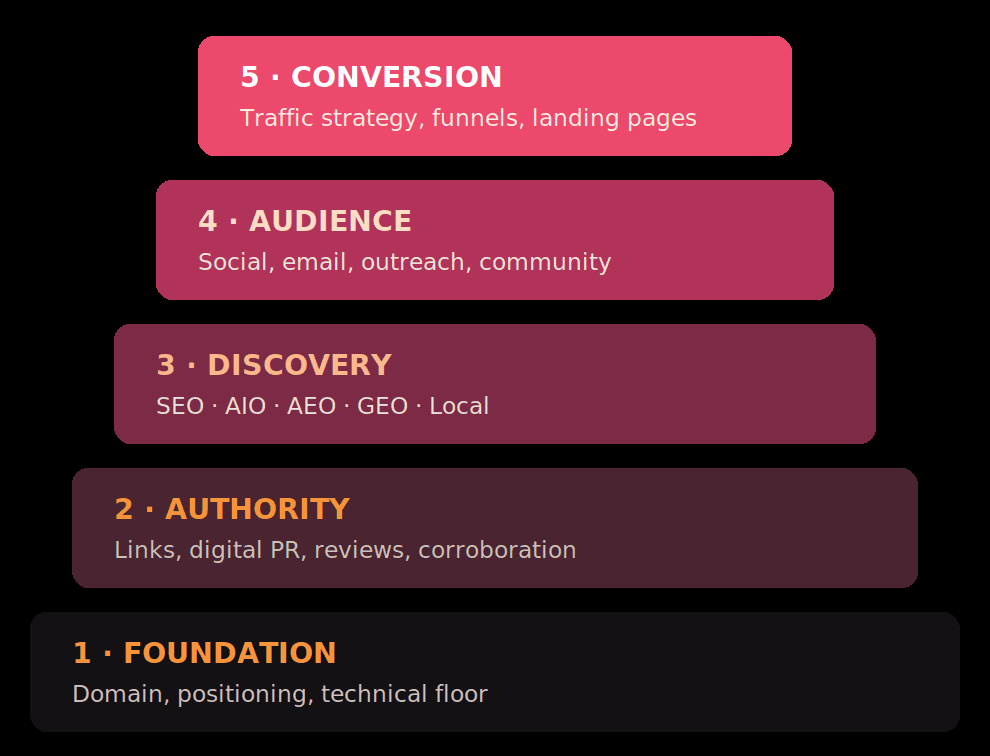
The Signal Stack
Five layers, bottom up. The return on any single channel is capped by the weakest layer underneath it, which is why the book refuses to start with tactics.
Figure 2.3
The Signal Loop
Measure, diagnose, reinvest. Score all five layers monthly and the next quarter belongs to the weakest one, rather than to whichever channel is loudest.
Figure 8.1
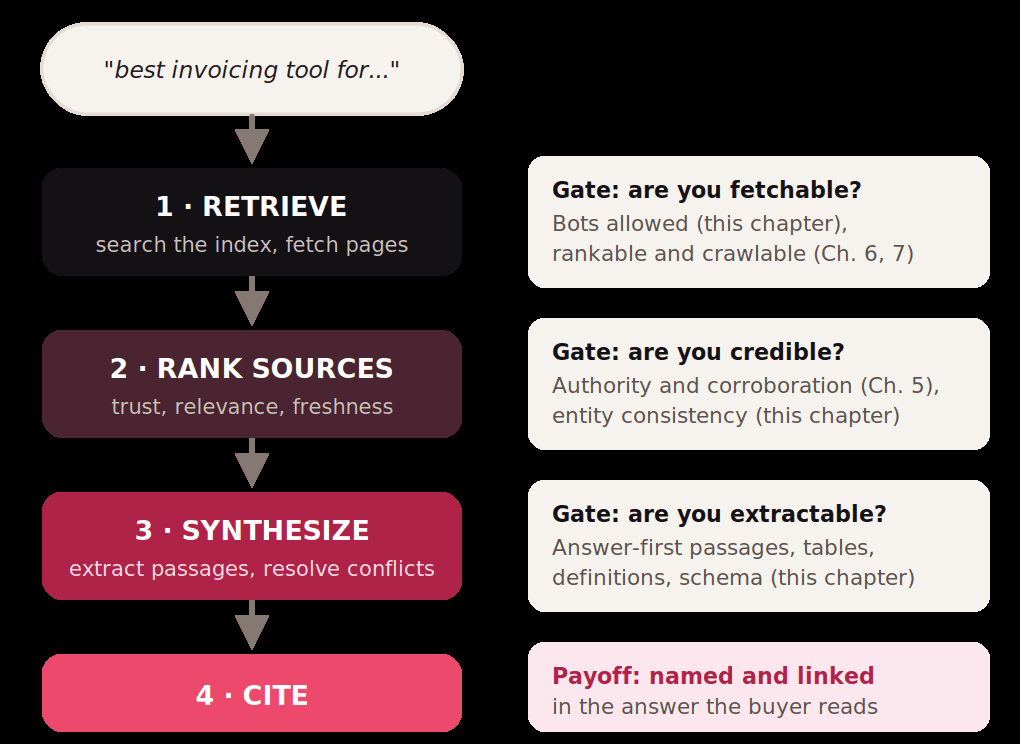
How an assistant assembles an answer
Retrieve, rank, synthesize, cite, and the gate your site has to pass at each stage. Fail the first one and nothing downstream matters.
Figure 5.1
The authority flywheel
Linkable asset, pitch, links, authority, rankings, traffic, and back to the next asset. Each turn of the wheel is cheaper than the last.
Contents
All 27 chapters
Eight parts, front to back, with the page each one starts on. Nothing is held back for a course.
Part I
The Operating System
1
01Marketing Fell Apart2
02The Signal Stack10
Part II
Foundation
17
03The URL Is a Business Decision18
04One Sentence Before Everything30
Part III
Authority
44
05How Authority Is Actually Earned45
Part IV
Discovery
59
06Search Still Pays the Bills60
07The Technical Floor71
08AIO: Make Your Site Legible to Machines93
09AEO: Become the Answer107
10GEO: Visibility Inside Generated Results129
11Win the Map and the Neighborhood149
Part V
Audience
160
12Social That Compounds161
13The Inbox Is Still Undefeated193
14Cold Outreach Without Burning Your Name204
Part VI
Conversion
227
15Traffic Is a Means, Not a Metric228
16The Landing Page, Inch by Inch: Anatomy246
17The Landing Page, Inch by Inch: Behavior276
Part VII
Momentum
301
18Rooms Full of Buyers302
19The Signal Loop in Practice326
20The Mistake Index338
21The Other Buyers: Sales Pages, Investors, and Raising in Public344
Part VIII
The Craft and the Money
365
22Words That Sell: The Copy Layer366
23The Offer: What You're Actually Selling381
24Paid, Properly: The Ads Playbook398
25Keep, Grow, Multiply: Retention and Referral414
26The Money Math: Budgets, CAC, and Hiring429
27The AI-Run Marketing Department444
Plus 6 appendices
The part most books leave out: the worksheets, the scorecard you grade yourself against, and the reading behind it.
A The Worksheet Library
B The Scorecard
C Glossary
D The Expert Check
E The Follow List
F Sources and Further Reading
Read a page
The cost of fragmentation
Every founder recognises this story. Most have lived some version of it and drawn the wrong conclusion from it.
Chapter 1 · page 3
Watch what fragmentation does inside a real business. A founder reads that content marketing works and commissions ten blog posts. The posts are decent, but the site's technical foundation was never audited, so half of them are effectively invisible to crawlers.
Nobody built links, so the domain has no authority and the posts rank on page four, where click-through rounds to zero. A few visitors arrive anyway; the landing page asks them for nothing, so they leave anonymously.
Six months later the founder concludes that content marketing doesn't work, cancels the program, and buys ads instead. The ads click through to the same leaky page.
Nothing in that story failed because of bad tactics. Each piece failed because a different piece was missing somewhere else.
What you get
A reference, not a read-once
The appendices are the part most marketing books leave out. They are why this one stays on the desk.
27 chapters
Foundation through to the money math, in install order
52 figures
Diagrams that carry the argument, not decoration
The Worksheet Library
Appendix A, fill-in sheets for every layer
The Scorecard
Appendix B, grade all five layers in under an hour
The Mistake Index
Chapter 20, the errors that cost the most, ranked
The 90-day install plan
Chapter 19, what to do in which order
The Expert Check
Appendix D, how to tell if an agency knows its trade
The Follow List
Appendix E, who is actually worth reading
Written for
Founders doing their own marketing and losing to worse products
Marketers who own several channels and no coherent system
Agencies who need one reference their whole team works from
Anyone whose category is being answered by ChatGPT before it reaches them
Not written for
Anyone looking for a single growth hack
Teams who want tactics without touching their foundation
Readers who want theory with no worksheets attached
Inside
What it covers
SEO, AIO, AEO and GEO
Domain strategy and authority building
Local, social, email and outreach
Landing pages inch by inch
Launch days, events and webinars
The 90-day install plan
For everyone with something good that goes unseen. Distribution is a solvable problem, and this is the book I wish someone had handed me.
Dedication
The author
Girish Kotte
An AI architect and serial founder who builds and markets his own products, which is where every system in this book was pressure-tested first. Twelve years building software, five of them leading engineering at Asset Panda, and deep in AI since the day ChatGPT launched.
The same method runs Wysera, PostWyse and BrandWyse. The book is the argument; the products are the proof.